Sunday, 9 October 2011

Gambling

Betting's influence pervades both society and government

Most forms of betting are lawful here, and Australians seem to be obsessed with all of them.  It has been estimated that they spend more per capita on gambling than any other nation on earth.  In 2009-10, in the state of Victoria alone, almost $1,000 was lost for every man, woman and child.

The number one culprits are the "pokies".  These are the Australian version of the slot machine, or one-armed bandit - so called because the symbols on the reels are often those of a deck of cards, reminiscent of a game of poker.  They account for the majority of the money lost nationally, and have the strongest association with problem gambling.

It is difficult to overstate the degree to which parts of Australian society have become dependent on gambling.  Sporting clubs all over the country, from the professional level down, rely on income generated from battalions of pokies stationed in purpose-built clubhouses.  The Returned and Services League (the Australian veterans association) is also in on the act.  Meanwhile, many pubs have built large annexes or turned over significant space to dedicated rooms, all filled with the clicks and chirrups of the omniscient machines.  These things matter in a vast country where these bodies are often the focus of social life in the community.
Believe it or not, this is probably a sports club

Meanwhile, professional sporting bodies, such as the Australian Football League and the National Rugby League, are becoming increasingly interested in the possible revenue accruing from a newer kid on the block - sports gambling.  The TV companies are, it seems, only too willing to help.  Live sports broadcasts are peppered with news-style announcements of the latest betting movements on the game.  Young fans, many of whose parents are already supporting their favourite teams with varying quantities of pokie revenue, are exposed to a barrage of advertising suggesting that they will only extract the full relish from the contest if there's money on it.

With the advent of the internet and smart phones meaning that punters can now drop thousands of dollars in the comfort of their own home, or even on the train to work, many Australians do accept that their country has a gambling problem.  However, the nation's constitutional arrangements mean that Australia is uniquely poorly placed to deal with it.  For its state governments, which are responsible for licensing and regulating gaming, are among those most addicted to the revenue it generates.

Under the constitution, the states have conceded the vast majority of their tax-raising powers to the federal government.  This leaves them reliant on a few sources of revenue, of which the duty paid on gambling is one of the most important.  On average, each state relies on gaming for around 10% of its income.  This in turn this makes them particularly susceptible to the powerful lobbies of the clubs, sporting bodies and betting companies, even when their governments recognise the damage that betting causes.  

Although the federal government has no specific power over gambling, it could partially regulate it under its other powers.  However, this would be messy and would probably leave loopholes.  The best option may be for the Federal and State government to negotiate any changes to the law.  However, this means that desirable changes could be watered down via the gambling lobby's influence at State level.

Matters have come to a head because the minority federal government is relying on support from independent MPs, one of whom - Andrew Wilkie - is demanding reform of the pokies laws.  In particular, he wants gamblers to have to commit to a maximum loss before playing certain machines, which will then cut them off when it's reached, and restrictions on cashpoints in gambling locations.

These may seem like fairly minor reforms, but they're being fought tooth and nail by the various lobby groups, who don't appear to be embarrassed about running apparently inconsistent arguments.  For example, it's difficult to see how they can confidently assert both that club revenues will drop by 40% (potentially driving them out of business) and that problem gamblers are unlikely to be helped, but they have done.

In the meantime it's estimated that 2% of Australians are problem gamblers, and that their problems each affect another 5 to 10 people.  If this is so, then between 12% and 22% of Australians suffer as a result of gambling.  Enough to demand some action, you'd think.


For an excellent article incorporating a personal and statistical take on the social and societal problems of gambling in Australia see http://thefailedestate.blogspot.com/2011/09/waiting-for-feature.html


Saturday, 8 October 2011

Coffee

Melburnians raised a glass when the US coffee giant Starbucks announced, a couple of years back, that it was closing most of its Australian stores, including sixteen in Melbourne.


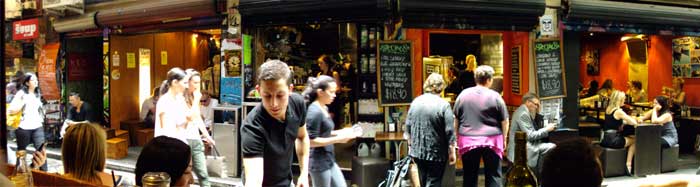
Chances are that most of the glasses contained coffee - but not of the Starbucks variety.  For coffee, more than any other beverage, is what makes Melbourne tick.  Virtually everywhere you go in the city and its suburbs you will find legions of independent cafés and kiosks, each of them with a loyal clientele convinced that they serve the best beans in town.


Melbourne in action
Coffee is the drink that powers business, gets everyone through the day, and is the excuse for sneaking out to network, or just catch up with friends.  As in other cities, most large office buildings have their own dedicated cafés to meet the needs of the workers' caffeine addiction on the doorstep.  Unlike many other cities, having a captive client base does not seem to prevent them trying to serve the very best cupfuls they can.  Possibly the best coffee I've had in Melbourne came from one of these places, which probably had hardly any passing trade at all.


Quite why Melbourne should have developed an obsession with the coffee bean that dwarfs that of any other city in Australia is something I've yet to get to the bottom of.  Certainly it seems that during the 19th century, while the rest of the British Empire was drowning in an ocean of tea, Melburnian office workers were staying awake during the day with nips of coffee.  Then, after the Second World War, large numbers of Italians migrated to Australia, bringing their love of the beverage with them.  By some distance, Melbourne was the city of choice for these new Australians.


Coffee also seems the natural drink for a city that prides itself on its metropolitan sophistication.  Some of its hipper residents, when they deign to think of Sydney at all, probably imagine the inhabitants of Melbourne's brasher northern sister getting by on Fanta and fruit cordial.


It was into this market that Starbucks stepped in 2000.  In retrospect they never stood a chance. Although in fact there were plenty who told them that at the time as well.  The coffee giant has been in full retreat throughout Australia, but in Melbourne it has been reduced to a token five outlets.  There can't be many cities of 4 million inhabitants where it's been routed to that extent.


It's a heartening story.  Australia - and Melbourne in particular - have proved that so long as there are enough little guys, and they do what they do well enough, the major multinational doesn't stand a chance.


Friday, 7 October 2011

The strange decline of Paul Hogan

I eased my backside onto a bar stool and ordered a beer.  One of my neighbours heard the accent and, in a voice that bespoke years of smoking heavy tar and gargling with ironmongery, asked me where I came from.  I said I was from England, to which he replied "What the **** d'you wanna come from there for?", and dissolved into guffaws of laughter.


Both Australia and I have come a long way since that encounter in 1991, though since it took place in Tully, Far North Queensland, that was probably always going to be the case for me - it's a long way from most places.


Back in those days, Paul Hogan was the undisputed international face of Australia, and my friend clearly fancied himself as having been cast from the same mould.  When he wasn't punching out crocodiles and blowing the froth off cold ones as Crocodile Dundee, "Hoges" was hurling bucketloads of shrimp onto barbies and blowing the froth off cold ones in adverts for Australian tourism or Fosters lager.  Generally he'd conclude with a laconic remark at the expense of some hapless foreigner, though fortunately his material tended to be of a higher standard than was available in Tully.
The Glory Years


They say that advertising works best when it uses some sort of truth about the product.  And whilst I wouldn't pretend that any of those images represented the whole story, at the time they still reflected a recognisable facet of mainstream Australia.  You didn't really have to go looking for it in out of the way places.  Bars in most parts of the country had examples of people hewn from the same slabs of Australian granite as "Hoges".  Hard-working, hard-drinking, hard-bitten bastards who had a put-down for every occasion.  


If you were English, it was an archetype you recognised all too well:  this was the same stock as the Allan Borders and David Boons, who could thrash the Poms at cricket and be back at the bar before their beer had got warm.


Old stereotypes die hard.  Many of the tourists and backpackers who arrive in Australia for the first time today probably still have expectations of a country bursting at the seams with Paul Hogan clones.  Some may even be hoping for it.  But beneath the kangaroo scrotum purses, stuffed cane toads and merchandise festooned with the logos of various beer companies, all of which can be found in any tourist shop, modern Australians hide a little secret.  


Which is that a visitor is overwhelmingly likely to find that they're friendly, courteous and helpful, and laconically-delivered insults are in short supply.  They drink less than they did as well, and in the cities lower-alcohol beers have become common, as has blokey one-upmanship involving hair-raisingly physical sporting activities.  If you're looking for an experience out of an old lager advert you're increasingly going to have to get off the beaten track a bit.


I'm sure that my friend from the bar stool in Tully is still there, probably in both the literal and figurative senses.  And Australia boasts plenty of places which are far remoter than that.  Tough places breed tough people, who generally aren't too bothered about offending anyone.  


But most Aussies don't live in tough places.  Out of a population of about 22.7 million, around 14.3 million live in one of the state or territory capitals, and quite a lot of the others probably live in other urban centres.  Australia's character is now substantially metropolitan, and it's in these areas that the Hogan archetype has declined.

The sort of bloke who doesn't play cricket against
England any more, thankfully
For all the warm welcome you'll get in Australia these days, there are some downsides to it.  The Australian cricket team's current travails have been partly blamed by some on the lack of precisely the sorts of hard-nosed characters they used to pick.  And I suppose we should mourn the gradual passing of character traits that used to distinguish the country immediately from others, though fortunately for the tourists you can still find them further away from the more built up areas.

As for Paul Hogan, he has followed his own archetype and now lives largely in self-imposed exile in Los Angeles, having spent many years in battles with the Australian tax authorities concerning the proceeds of "Crocodile Dundee".


On a more personal level, the British now drink substantially more than the Australians, which means that at social occasions I am now often drunker and ruder than the locals.  This is a cross that my wife bears with her usual stoicism.


Thursday, 6 October 2011

McMansion

Honey, the house ate the garden

When they think of Australia, people often imagine everyone enjoying the warm weather outside, and healthy kids learning sport or just playing in the back yard.  Many Australian families do live like that .  But an increasing number of them are opting to build or buy houses so large that they virtually eliminate any usable garden space.  They have supersized, and their home has become a McMansion.

They're pretty easy to spot.  They're so damn huge, for one thing.  Many of them have a large side order of ugly to go with that.  Often they're built in the outer suburbs, where land values are much less than in more established areas.  This seems to have encouraged families to spend  what they've saved by moving out there on covering virtually every square metre of the plot with house.  


Unfortunately, their popularity has encouraged increasing numbers of homeowners and developers to tear down smaller houses on good-sized plots in more established suburbs and build all over them as well.  What all of these places have in common, apart from their size, is a pocket-sized back garden, sometimes not more than three metres across, and often impractically L-shaped along two sides of the house as well.
It probably looks worse from the other sides

The extra space inside is given over to extra bedrooms, home theatres, "entertainment zones" or simply outsize hallways, kitchens and living areas.  Over the past half century the number of Australians per household has dropped by 30% but the size of houses has doubled.

The environmental impact of all this is profound.  Australia is already one of the highest per capita consumers of energy in the world, and these monstrosities are air conditioned throughout the summer and heated in the winter.  The outer suburbs where they conglomerate are already poorly served by public transport, and such low-density housing makes what there is even less practical, leading to increased reliance on the motor car.  Moreover, the sheer quantity of land concreted over to build them increases water run-off and therefore the risk of flooding.

Some have argued that one of the driving factors in the growth of the McMansion has been the desire for ostentation, often by those who can't really afford it.  Certain aspects of the phenomenon seem to bear this out.  Although there is often little in the way of usable outdoor space (for the kids to play in, for example), some land is generally found for a formal front garden whose only apparent purpose is to give the house "kerb appeal".  Often the only part of the exterior that looks as if any thought has been put into its appearance is the front, with the sides in particular often resembling those of a shop or industrial unit.

It has been claimed that the market for McMansions is declining.  The turbo-charged Australian housing market has lost some of its edge, and some of their disadvantages may only become fully apparent after purchase.  These include the eye-watering running costs, and the need to travel everywhere by car in an era of rising fuel costs.  We'll see.  In the meantime, McMansions are still being built, and they are likely to remain a feature of the Australian environment for many years to come.


For a readable summary of some of the problems posed by the McMansion phenomenon, this article by Professor Terry Burke may be of interest.