Monday, 3 October 2011

Magpie Attack!

"One for sorrow, two for joy, three for a girl, four for a boy".  The English poem about the European Magpie's supposed connection with prophecy is well-known.


That sort of whimsy is less evident in Australia, where the native magpie boasts a beady eye, a razor-sharp beak and a potentially villainous disposition.
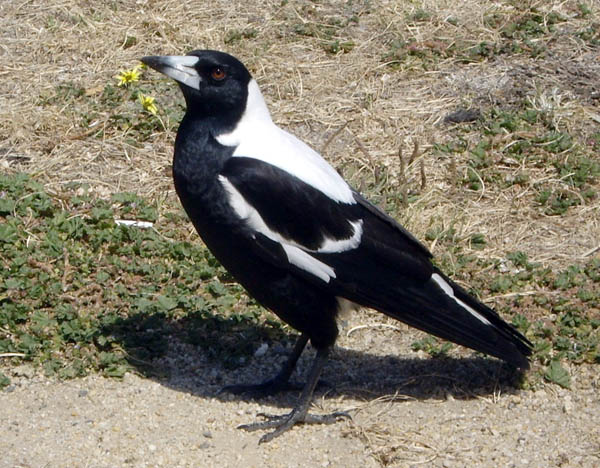
A magpie:  he may be up to no good (photo ozladym.com)
They're also extremely common in the populated areas of the country, and if you call Australia home it's very likely that you have some living near your house.  For most of the year, magpie and mankind exist in perfect harmony, and many people will feed them when they visit their gardens.  But in the springtime - say from September through to November - it's magpie swooping season, when a small minority do their best to ensure that the rest remain unpopular all year round.

"Swooping season" sounds fun, but it's when some male birds become highly aggressive,  swooping down to attack people who approach their nests whilst they contain eggs or chicks.  It doesn't matter whether you're intending them any harm, and virtually all victims are entirely innocent of any magpie malice - most attacks occur 50 to 100 metres from the nest.  Simply walking nearby can be enough to trigger one, and passing cyclists are common targets.


Man v magpie: this time it's a tie (photo

sunshinecoastdaily.com.au)
It would be wrong to pretend that magpie attack is a major  danger.  No one that I've heard of cowers in their house for fear of being swooped.  The proportion of males who exhibit this behaviour is small - apparently beneath 9% - and their presence is welcomed by some people.  Their song is complex, and highly distinctive of Australia, and as in other countries they have been adopted as the mascots of sporting teams, particularly those who play in black and white.


But a magpie attack, if it comes, is highly disconcerting.  For one thing they prefer to attack the back of the head, which means that there is rarely any warning.  Very occasionally, an attack can have serious consequences - they can inflict serious injury and their habit of flying at cyclists has caused a death in one relatively recent case.  In the vast majority of cases, though, the worst that will happen is that you'll get a fright and have a story to tell, like this lady who experienced a swooping attack from a mynah bird (similar in effect, far less common in practice).


The cable tie technique (photo
http://www.singletonargus.com.au/)
What can you do about it?  Well, as a native species, magpies are protected by law, so if you take matters into your own hands and attempt to harm one you'll find yourself in a lot of trouble - even if it attacked you first.  Whilst some states do allow the authorities to execute delinquent birds, official policy is generally to catch and release them in unpopulated areas.  Meanwhile, many cyclists adopt a variety of defensive strategies which are supposed to help, though none is scientifically proven to be 100% effective.  As magpies don't like to attack people who are looking straight at them, some try to fool them with eyes painted on the tops of their cycling helmets or by wearing sunglasses on the back of the head.  Others reckon that a series of cable ties protruding vertically from the top of a bike helmet will distract them and at least keep them away from the face, though this technique is perhaps not recommended for the sartorially aware.  

Fortunately, most magpies won't attack anyone, and because it's not a year-round phenomenon the chances are it won't happen to you.  And remember:  unlike spiders, you're never going to have to remove them from the bathroom at 11pm at night.


Sunday, 2 October 2011

Grand Final

One city's obsession with Aussie Rules Football

Australian rules football is the game that Melbourne gave the world, and if most of the rest of the world didn’t take any notice, then stuff ‘em.  The game may now be played professionally throughout Australia, but if you speak to any Melburnian on Grand Final weekend, you can’t escape the sense of proud ownership that they feel about the game that captivates them above all else.

A night game at the MCG (courtesy blog.travelpod.com)
The Grand Final is the last match of the season in the elite Australian Football League  (AFL) and the winners are crowned champions for the year.  Wherever the finalists are from, it’s always played at the Melbourne Cricket Ground, arguably the most hallowed turf in Australia, and in the week beforehand it’s difficult to find anyone in town who professes no interest in the outcome. 


Any new arrival in Melbourne will have had the experience of being mobbed at social events with concerned questions about which football team they intend to support.  If you even hint that you’re undecided, the questioner will switch to an evangelical promotion of the merits of his or her own team, complete with a vague assurance that God has chosen them to do His work on earth, and dire warnings that certain other teams are most definitely in league with the dark side.

You know that you’re in the midst of sporting obsession when you turn on the car radio and discover that the second item in the news is a story about one of the top players (Chris Judd of Carlton, since you’re asking), and his plans for the conception of his next child (as soon as possible, please).

What’s it all about?  Well, “footy” is played with an oval ball, on an enormous  oval pitch, by two teams of eighteen lung-bustingly fit and spectacularly athletic specimens of Australian manhood.  The aim is to kick the ball through your opponent’s goal posts as often as possible, which gets you six points each time.  In order to do this, players can kick or handle the ball, but generally will try to catch the kicked ball before it bounces.  This is called a “mark” and entitles you to a free kick, which they can either use to try and set one of their own side up for another mark or to score a goal.  Australians aren’t known for their sympathy for losers, but in the case of “footy” they make an exception:  if you miss the goal by only a little bit, your team is awarded a single consolation point. 

West Coast's Sampi takes a spectacular aerial mark
(Photo T Collens published at www.smh.com.au)

That, really, is all you need to know in order to attend your first game, where you will find tens of thousands of people who are far more knowledgeable than me to explain the finer details.

Football has, since its inception, had a reputation for the extreme levels of violence that its practitioners can inflict on each other.  You can still hear old-timers telling you, with misty eyes, of the occasion when so-and-so ran fifty yards for the sole purpose of punching them whilst their back was turned.  The advent of television has dulled this somewhat, but it's still not a game for the faint hearted - the players have learned to inflict injury with a variety of shoulder charges and flailing arms or elbows which stand a better chance of being deemed accidental.  Violence is certainly more likely to pay in football than in other sports:  it is unheard of for a player to be sent off, no matter what depth of skulduggery he has indulged in.  The downside, for the aggressor, is that his villainy is likely to have been recorded on television, and games in the AFL tend to be followed by a series of disciplinary tribunals at which malefactors are paraded and justice is meted out.

It’s also probably worth mentioning that some footballers share the same regard for personal abstinence, political correctness and women’s rights for which players of the various football codes are known throughout the English-speaking world.  And now I have mentioned it, I will move quickly on.

2011’s Grand Final was contested yesterday between Collingwood and Geelong.  Collingwood is as close to being the Manchester United or New York Yankees of its sport as AFL gets.  It’s the richest club, with the most supporters, and is historically one of the most successful; its status as the outfit most likely to be identified by supporters of other teams as being in league with Satan is probably not coincidental.  Geelong is the most successful side of the past five years.

As for the game, well, what do you want to know?  It was something of a classic, which Geelong won 119-81 in the final quarter after what had been a very even game.  A great deal of beer was drunk, we all picked a side and had a shout.  And Melbourne is now counting the days until the start of the next season…